|
|
 |
 | Wine |
|
| Champagne Chronicle |
 |
|
 |
| Ernie Salas explores the rarified world of the prestige cuvee –the world's most exclusive and expensive sparkling wines |
 |
|
 |
JULY 14, 1789 PARIS FRANCE —Thousands of furious Parisians defi ed their King, Louis-Auguste by successfully storming a fortified prison called the Bastille; shortly after, they celebrated with a sparkling wine from the Champagne region.
September 26, 1934 CLYDEBAND, ENGLAND —Her Majesty, the Queen cracked a magnum bottle of French champagne across the bow of the Cunard Steamship Company's "Ultimate Ship", her namesake, "The Queen Mary". From setting off the French Revolution to launching an epoch of luxury travel, Champagne's frequent appearances in history certainly provoke an interest in what's behind this bubbling potion in the glass bottle. |
|
 |
| The Origin |
 |
While the word "Champagne" is often used to describe a wide variety of sparkling white wines from around the world, real Champagne is solely produced in France's Champagne Wine Region.
The region has a unique "chalky" soil that is ideal for grape production, and ultimately contributes to the characteristic lightness of the region's Champagne wine. A cool climate during growing & harvesting season also produces highly acidic grapes best suited for sparkling wine.
Champagne region vineyard exports are estimated at upwards of 400 million bottles, with most bottles of Champagne sold today made with non-vintage grapes, or made from multiple vintages (grapes that were produced over two or more years). The primary focus of non-vintage blending is to produce Champagne whose traits are consistent with a particular Champagne House. |
|
 |
| Prestige Cuvee |
 |
But there is a line of champagne that stands head and shoulders above the rest. Vintage Champagne, also known as prestige cuvée, is made from a single vintage in an especially good year (for weather & grape production).
One wine critic describes the Prestige Cuvees as "the pinnacle of achievement... the ultimate expressions of the house (that created it). (It is) the wine that represents their finest vineyards, grapes, and the Cellarmaster's know-how."
Only the finest grapes, hand-selected from the top-producing vineyards go into a Prestige Cuvee. These grapes are carefully pressed, and the wines, blended and bottled into a special container. The Champagne is then left to mature for as long as seven years before it enters the market.
Because the production process is more focused on celebrating the actual vintage (rather than the overall style & fl avor of the Champagne house), the tastes are apt to be more unique and fl avorful. In addition, because prestige cuvee Champagne is made less frequently & in smaller amounts, the demand provides a higher level of prestige as well as price. These Prestige Cuvees fall into the luxury category—savoured by a few who are deemed to be more discriminating and in the know than the rest. |
|
 |
| Works of art |
 |
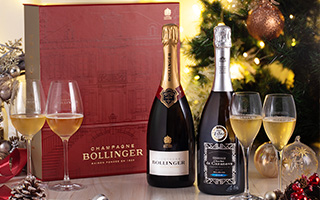
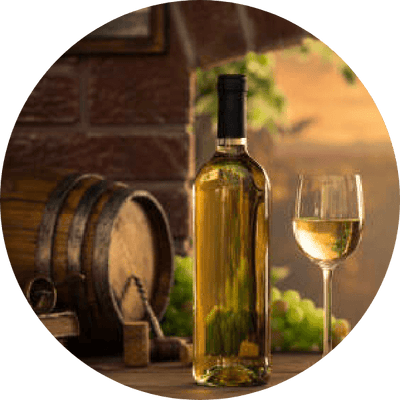
For the most part, Champagne is mostly found in bottles of two sizes; 750 ml standard bottles and 1.5L magnums. The bottles themselves are a picture of both practicality & elegance; the distinctive mushroom cork, rounded lines & heavy weight green glass, safely contain the carbonation while subtly pleasing the eye. The labels, in addition to providing the Appellation (grape origin), Champagne House & Level of Dosage, are drawn like pieces art themselves.
Prestige cuvees are, more often than not, placed in bottles that are deemed worthy of their contents—so that many become, in themselves, collectors' items. |
|
 |
| Writer Favorites |
 |
|
|
 |
| Louis Roederer Cristal Rose 2000 |
 |
| Champagne Louis Roederer was founded in 1776 in Reims, France and is one of the rare family owned companies, which is still managed by the Roederer family. The Cristal 2000 is a unique Champagne, the result of a technique known as skin maceration in its winemaking. |
|
 |
| Lanson 1996, 1990 and 1976 (all in Magnums) |
 |
| Champagne Lanson was founded in 1760 and is one of the oldest Grande Marque Champagne Houses. Lanson is the fourth largest Champagne House in the world is known for its rigorous selection process of its great vintages. |
|
 |
| Bollinger Quantum of Solace Limited Edition |
 |
| Six generations of the Bollinger family have maintained their trademark style, and Bollinger is one of the rare Grande Marque houses to be owned, controlled and managed by the same family since it was founded. Its Quantum of Solace Limited edition is a bullet-shaped Champagne bottle, that has Bollinger 2007 inscribed on the exterior. |
|
 |
| Taittinger Art Collection 1998 by Zao Wou-Ki |
 |
| Champagne Taittinger was established in 1931 by Pierre Taittinger on the foundations of Forest-Forneaux, itself established in 1734 and the third-oldest wine producing house of Champagne. The Taittinger Art Collection series are created from a selection of the year's fi nest cuvees. The Champagne is contained in a bottle decorated by Chinese artist Zao Wou-Ki |
|
 |
| Philipponnat Reserve Millesime 1976 |
 |
| The House of Philipponnat Champagnes are ageing slowly in total silence and perfect darkness in their historical cellars dating back to the 18th century. Philipponnat is heir to traditions maintained by generations of cellar masters. Also, the House of Philipponnat has an exceptional collection of Old Vintage Champagnes quietly ageing on lees in cellars whose exact location is a closely guarded secret. |
|
|
 |
 |
 |
 |
|
 |
|
|
|
|